Were There Any Art or Literature Movements in the 19th Century Duriing the Second Great Awakening
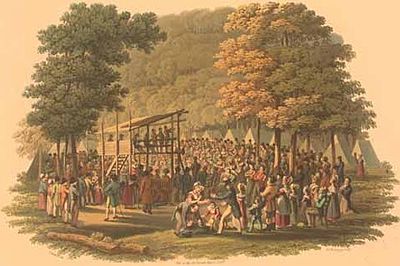
A Methodist camp meeting in 1819 (paw colored)
The Second Peachy Awakening was a Protestant religious revival during the early 19th century in the United states. The Second Slap-up Awakening, which spread religion through revivals and emotional preaching, sparked a number of reform movements. Revivals were a key part of the movement and attracted hundreds of converts to new Protestant denominations. The Methodist Church used circuit riders to reach people in borderland locations. The 2d Smashing Awakening led to a flow of antebellum social reform and an emphasis on salvation by institutions. The outpouring of religious fervor and revival began in Kentucky and Tennessee in the 1790s and early 1800s among the Presbyterians, Methodists and Baptists. The awakening brought comfort in the face of uncertainty as a consequence of the socio-political changes in America.
It led to the founding of several well known colleges, seminaries, and mission societies. The Great Awakening notably altered the religious climate in the American colonies. Ordinary people were encouraged to brand a personal connection with God, instead of relying on a minister. Newer denominations, such as Methodists and Baptists, grew apace. While the movement unified the colonies and boosted church building growth, experts say[ which? ] it likewise acquired sectionalisation.
Historians named the Second Great Enkindling in the context of the Starting time Great Enkindling of the 1730s and 1750s and of the Third Great Awakening of the late 1850s to early 1900s. The 2nd and Third Awakenings were office of a much larger Romantic religious movement that was sweeping across England, Scotland, and Frg.[1]
New religious movements emerged during the Second Great Enkindling, such as Adventism, Dispensationalism, and the Latter 24-hour interval Saint motion.
Spread of revivals [edit]
Background [edit]
Like the First Cracking Enkindling a one-half century earlier, the Second Cracking Enkindling in North America reflected Romanticism characterized by enthusiasm, emotion, and an appeal to the supernatural.[2] Information technology rejected the skepticism, deism, Unitarianism, and rationalism left over from the American Enlightenment,[3] about the same time that like movements flourished in Europe. Pietism was sweeping Germanic countries[iv] and evangelicalism was waxing strong in England.[5]
The 2d Great Enkindling occurred in several episodes and over different denominations; however, the revivals were very similar.[3] Equally the well-nigh constructive form of evangelizing during this menstruation, revival meetings cut beyond geographical boundaries.[6] The motion quickly spread throughout Kentucky, Indiana, Tennessee, and southern Ohio, likewise every bit other regions of the United states of america and Canada. Each denomination had avails that allowed it to thrive on the frontier. The Methodists had an efficient organisation that depended on itinerant ministers, known as excursion riders, who sought out people in remote frontier locations. The circuit riders came from among the common people, which helped them establish rapport with the frontier families they hoped to convert.
Theology [edit]
Postmillennialist theology dominated American Protestantism in the first half of the 19th century. Postmillennialists believed that Christ will return to globe after the "Millennium", which could entail either a literal ane,000 years or a figurative "long period" of peace and happiness. Christians thus had a duty to purify order in training for that render. This duty extended beyond American borders to include Christian Restorationism. George Fredrickson argues that Postmillennial theology "was an impetus to the promotion of Progressive reforms, as historians accept often pointed out."[seven] During the Second Great Awakening of the 1830s, some diviners expected the millennium to get in in a few years. Past the late 1840s, however, the dandy day had receded to the afar futurity, and postmillennialism became a more than passive religious dimension of the wider heart-grade pursuit of reform and progress.[7]
Burned-over district [edit]
Get-go in the 1820s, Western New York State experienced a series of popular religious revivals that would later earn this region the nickname "the burned-over district," which implied the area was fix ablaze with spiritual fervor. This term, nonetheless, was not used by contemporaries in the first half of the nineteenth century, every bit it originates from Charles Grandison Finney's Autobiography of Charles G Finney (1876), in which he writes: "I found that region of country what, in the western phrase, would be called, a 'burnt district.' There had been, a few years previously, a wild excitement passing through that region, which they chosen a revival of organized religion, but which turned out to be spurious."[eight] [9] Charles Finney, a leading revivalist active in the area, coined the term.[10] During this period, a number of nonconformist, folk faith, and evangelical sects flourished in the region, including the Mormons, Millerites, Adventists, Jehovah's Witnesses, and Shakers. Spiritualism was also popular in Western New York during this menses, with the Lily Dale customs and the Flim-flam Sisters playing a defining office in the motility'southward development.
The extent to which religious fervor actually impacted the region was reassessed in final quarter of the twentieth century. Linda K. Pritchard uses statistical data to testify that compared to the rest of New York State, the Ohio River Valley in the lower Midwest, and the country every bit a whole, the religiosity of the Burned-over District was typical rather than exceptional.[xi] More contempo works, notwithstanding, accept argued that these revivals in Western New York had a unique and lasting impact upon the religious and social life of the entire nation.[12] [13] [xiv]
West and Tidewater South [edit]
On the American frontier, evangelical denominations, particularly Methodists and Baptists, sent missionary preachers and exhorters to meet the people in the backcountry in an effort to support the growth of church membership and the formation of new congregations.[ commendation needed ] Another fundamental component of the revivalists' techniques was the military camp meeting. These outdoor religious gatherings originated from field meetings and the Scottish Presbyterians' "Holy Fairs", which were brought to America in the mid-eighteenth century from Ireland, Scotland, and Britain's border counties. Well-nigh of the Scots-Irish gaelic immigrants before the American Revolutionary War settled in the backcountry of Pennsylvania and downwardly the spine of the Appalachian Mountains in present-mean solar day Maryland and Virginia, where Presbyterian emigrants and Baptists held large outdoor gatherings in the years prior to the war. The Presbyterians and Methodists sponsored similar gatherings on a regular basis after the Revolution.[15]
The denominations that encouraged the revivals were based on an estimation of man's spiritual equality earlier God, which led them to recruit members and preachers from a wide range of classes and all races. Baptists and Methodist revivals were successful in some parts of the Tidewater South, where an increasing number of common planters, plain folk, and slaves were converted.[16]
West [edit]
In the newly settled frontier regions, the revival was implemented through camp meetings. These often provided the first run into for some settlers with organized organized religion, and they were important equally social venues. The army camp meeting was a religious service of several days' length with preachers. Settlers in thinly populated areas gathered at the camp meeting for fellowship as well as worship. The sheer exhilaration of participating in a religious revival with crowds of hundreds and perhaps thousands of people inspired the dancing, shouting, and singing associated with these events. The revivals also followed an arc of corking emotional ability, with an emphasis on the individual's sins and need to turn to Christ, and a sense of restoring personal salvation. This differed from the Calvinists' belief in predestination every bit outlined in the Westminster Confession of Faith, which emphasized the inability of men to save themselves and decreed that the only way to exist saved was past God's electing grace.[17] Upon their return home, well-nigh converts joined or created small-scale local churches, which grew rapidly.[eighteen]
The Revival of 1800 in Logan Canton, Kentucky, began as a traditional Presbyterian sacramental occasion. The commencement breezy camp coming together began in June, when people began camping on the grounds of the Red River Meeting Business firm. Subsequent meetings followed at the nearby Gasper River and Muddy River congregations. All 3 of these congregations were under the ministry of James McGready. A yr later, in August 1801, an fifty-fifty larger sacrament occasion that is generally considered to be America's first army camp meeting was held at Cane Ridge in Bourbon Canton, Kentucky, under Barton W. Rock (1772–1844) with numerous Presbyterian, Baptist, and Methodist ministers participating in the services. The six-twenty-four hours gathering alluring peradventure as many equally 20,000 people, although the exact number of attendees was non formally recorded. Due to the efforts of such leaders every bit Rock and Alexander Campbell (1788–1866), the camp meeting revival spread religious enthusiasm and became a major fashion of church expansion, particularly for the Methodists and Baptists.[19] [twenty] Presbyterians and Methodists initially worked together to host the early army camp meetings, but the Presbyterians eventually became less involved considering of the dissonance and oft raucous activities that occurred during the protracted sessions.[xx]
As a result of the Revival of 1800, the Cumberland Presbyterian Church emerged in Kentucky and became a potent back up of the revivalist movement.[21] Cane Ridge was as well instrumental in fostering what became known as the Restoration Motion, which consisted of not-denominational churches committed to what they viewed equally the original, fundamental Christianity of the New Testament. Churches with roots in this movement include the Churches of Christ, Christian Church building (Disciples of Christ), and the Evangelical Christian Church in Canada. The congregations of these denomination were committed to individuals' achieving a personal relationship with Christ.[22]
Church membership soars [edit]

1839 Methodist camp meeting
The Methodist circuit riders and local Baptist preachers fabricated enormous gains in increasing church membership. To a lesser extent the Presbyterians also gained members, especially with the Cumberland Presbyterian Church in sparsely settled areas. As a outcome, the numerical strength of the Baptists and Methodists rose relative to that of the denominations dominant in the colonial flow—the Anglicans, Presbyterians, Congregationalists. Among the new denominations that grew from the religious ferment of the 2nd Bang-up Enkindling are the Churches of Christ, Christian Church (Disciples of Christ), the Seventh-24-hour interval Adventist Church, and the Evangelical Christian Church in Canada.[22] [23]
The converts during the Second Great Awakening were predominantly female. A 1932 source estimated at to the lowest degree three female person converts to every 2 male converts between 1798 and 1826. Immature people (those under 25) also converted in greater numbers, and were the first to catechumen.[24]
Subgroups [edit]
Adventism [edit]
The Advent Movement emerged in the 1830s and 1840s in North America, and was preached past ministers such as William Miller, whose followers became known as Millerites. The proper noun refers to conventionalities in the soon 2nd Advent of Jesus (popularly known every bit the Second coming) and resulted in several major religious denominations, including Seventh-day Adventists and Advent Christians.[25]
Holiness move [edit]
Though its roots are in the Commencement Keen Awakening and earlier, a re-emphasis on Wesleyan teachings on sanctification emerged during the Second Keen Awakening, leading to a distinction betwixt Mainline Methodism and Holiness churches.
Restoration Movement [edit]
The idea of restoring a "archaic" form of Christianity grew in popularity in the U.S. after the American Revolution.[26] : 89–94 This want to restore a purer course of Christianity without an elaborate bureaucracy contributed to the development of many groups during the Second Great Awakening, including the Latter Day Saints, Baptists and Shakers.[26] : 89 Several factors made the restoration sentiment peculiarly appealing during this time period:[26] : 90–94
- To immigrants in the early 19th century, the country in the United States seemed pristine, edenic and undefiled – "the perfect identify to recover pure, uncorrupted and original Christianity" – and the tradition-bound European churches seemed out of place in this new setting.[26] : ninety
- A primitive faith based on the Bible alone promised a way to sidestep the competing claims of the many denominations bachelor and for congregations to detect assurance of being right without the security of an established national church.[26] : 93
The Restoration Movement began during, and was greatly influenced by, the Second Smashing Awakening.[27] : 368 While the leaders of one of the two primary groups making up this motion, Thomas Campbell and Alexander Campbell, resisted what they saw every bit the spiritual manipulation of the army camp meetings, the revivals contributed to the development of the other major branch, led by Barton W. Rock.[27] : 368 The Southern stage of the Awakening "was an of import matrix of Barton Stone's reform motility" and shaped the evangelistic techniques used past both Stone and the Campbells.[27] : 368
Culture and gild [edit]
Efforts to apply Christian teaching to the resolution of social problems presaged the Social Gospel of the tardily 19th century. Converts were taught that to accomplish salvation they needed not simply to repent personal sin but also work for the moral perfection of society, which meant eradicating sin in all its forms. Thus, evangelical converts were leading figures in a diverseness of 19th century reform movements.[28]
Congregationalists fix missionary societies to deliver the western territory of the northern tier. Members of these groups acted as apostles for the faith, and also equally educators and exponents of northeastern urban civilisation. The Second Neat Awakening served as an "organizing process" that created "a religious and educational infrastructure" across the western frontier that encompassed social networks, a religious journalism that provided mass advice, and church-related colleges.[27] : 368 Publication and education societies promoted Christian education; most notable among them was the American Bible Social club, founded in 1816. Women made up a big part of these voluntary societies.[29] The Female Missionary Club and the Maternal Clan, both active in Utica, NY, were highly organized and financially sophisticated women'southward organizations responsible for many of the evangelical converts of the New York frontier.[xxx]
In that location were likewise societies that broadened their focus from traditional religious concerns to larger societal ones. These organizations were primarily sponsored by affluent women. They did non stem entirely from the 2nd Groovy Awakening, only the revivalist doctrine and the expectation that ane's conversion would lead to personal action accelerated the office of women'southward social benevolence work.[31] Social activism influenced abolitionism groups and supporters of the Temperance movement. They began efforts to reform prisons and care for the handicapped and mentally ill. They believed in the perfectibility of people and were highly moralistic in their endeavors.
Slaves and free African Americans [edit]
Baptists and Methodists in the South preached to slaveholders and slaves alike. Conversions and congregations started with the Beginning Great Awakening, resulting in Baptist and Methodist preachers being authorized amidst slaves and free African Americans more than a decade before 1800. "Black Harry" Hosier, an illiterate freedman who drove Francis Asbury on his circuits, proved to be able to memorize large passages of the Bible verbatim and became a cross-over success, equally popular amid white audiences every bit the black ones Asbury had originally intended for him to minister.[32] His sermon at Thomas Chapel in Chapeltown, Delaware, in 1784 was the first to be delivered by a blackness preacher directly to a white congregation.[33]
Despite being called the "greatest orator in America" past Benjamin Rush[34] and ane of the best in the world by Bishop Thomas Coke,[33] Hosier was repeatedly passed over for ordination and permitted no vote during his omnipresence at the Christmas Conference that formally established American Methodism. Richard Allen, the other black attendee, was ordained by the Methodists in 1799, but his congregation of free African Americans in Philadelphia left the church there because of its bigotry. They founded the African Methodist Episcopal Church (AME) in Philadelphia. After showtime submitting to oversight by the established Methodist bishops, several AME congregations finally left to form the starting time independent African-American denomination in the The states in 1816. Before long after, the African Methodist Episcopal Zion Church (AME Zion) was founded every bit some other denomination in New York Metropolis.
Early Baptist congregations were formed by slaves and costless African Americans in South Carolina and Virginia. Peculiarly in the Baptist Church, African Americans were welcomed as members and as preachers. Past the early 19th century, independent African-American congregations numbered in the several hundreds in some cities of the Southward, such as Charleston, South Carolina, and Richmond and Petersburg, Virginia.[35] With the growth in congregations and churches, Baptist associations formed in Virginia, for instance, as well as Kentucky and other states.
The revival also inspired slaves to need freedom. In 1800, out of African-American revival meetings in Virginia, a plan for slave rebellion was devised past Gabriel Prosser, although the rebellion was discovered and crushed before information technology started.[36] Despite white attempts to command independent African-American congregations, particularly later on the Nat Turner uprising of 1831, a number of African-American congregations managed to maintain their separation as independent congregations in Baptist associations. State legislatures[ which? ] passed laws requiring them e'er to have a white man nowadays at their worship meetings.[35]
Women [edit]
Women, who made up the majority of converts during the Enkindling, played a crucial role in its development and focus. It is not clear why women converted in larger numbers than men. Various scholarly theories attribute the discrepancy to a reaction to the perceived sinfulness of youthful frivolity, an inherent greater sense of religiosity in women, a communal reaction to economic insecurity, or an assertion of the self in the face of patriarchal rule. Husbands, especially in the Southward, sometimes disapproved of their wives' conversion, forcing women to choose between submission to God or their spouses. Church membership and religious activeness gave women peer support and place for meaningful action outside the home, providing many women with communal identity and shared experiences.[37]
Despite the predominance of women in the motility, they were not formally indoctrinated or given leading ministerial positions. However, women took other public roles; for case, relaying testimonials about their conversion experience, or assisting sinners (both male and female person) through the conversion procedure. Leaders such equally Charles Finney saw women's public prayer as a crucial aspect in preparing a community for revival and improving their efficacy in conversion.[38] Women also took crucial roles in the conversion and religious upbringing of children. During the menstruation of revival, mothers were seen every bit the moral and spiritual foundation of the family unit, and were thus tasked with instructing children in matters of religion and ethics.[39]
The greatest change in women'due south roles stemmed from participation in newly formalized missionary and reform societies. Women's prayer groups were an early and socially acceptable form of women'south organization. In the 1830s, female moral reform societies rapidly spread across the North making it the first predominantly female social movement.[40] Through women's positions in these organizations, women gained influence outside of the private sphere.[41] [42]
Changing demographics of gender likewise affected religious doctrine. In an effort to give sermons that would resonate with the congregation, ministers stressed Christ'southward humility and forgiveness, in what the historian Barbara Welter calls a "feminization" of Christianity.[43]
Prominent figures [edit]
- Richard Allen, founder, African Methodist Episcopal Church
- Francis Asbury, Methodist, circuit passenger and founder of the Methodist Episcopal Church building
- Henry Ward Beecher, Congregationalist, son of Lyman Beecher
- Lyman Beecher, Presbyterian
- Antoinette Brown Blackwell, Congregationalist and later Unitarian, the first ordained female minister in the United states
- Alexander Campbell, Presbyterian, and early leader of the Restoration Movement
- Thomas Campbell, Presbyterian, then early leader of the Restoration Movement
- Peter Cartwright, Methodist
- Lorenzo Dow, Methodist
- Timothy Dwight Four, Congregationalist
- Charles Grandison Finney, Presbyterian and anti-Calvinist, 2nd president of Oberlin Higher
- "Black Harry" Hosier, Methodist, the first African American to preach to a white congregation
- Adoniram Judson, early Baptist missionary.
- Ann Lee, Shakers
- Jarena Lee, Methodist, a female AME circuit rider
- Robert Matthews, cult post-obit as Matthias the Prophet
- William Miller, Millerism, forerunner of Adventism
- Asahel Nettleton, Reformed
- Benjamin Randall, Free Will Baptist
- Luther Rice, Baptist missionary to India, and Baptist missionary in the US South
- Joseph Smith, The Church building of Jesus Christ of Latter-day Saints, early on leader of the Restoration Movement
- Barton Stone, Presbyterian non-Calvinist, and then early leader of the Restoration Movement
- Nathaniel William Taylor, heterodox Calvinist
- Ellen Chiliad. White, Seventh-day Adventist Church prophetess
Political implications [edit]
Revivals and perfectionist hopes of improving individuals and society connected to increment from 1840 to 1865 beyond all major denominations, particularly in urban areas. Evangelists often directly addressed problems such as slavery, greed, and poverty, laying the groundwork for later reform movements.[44] The influence of the Awakening continued in the course of more than secular movements.[45] In the midst of shifts in theology and church building polity, American Christians began progressive movements to reform society during this period. Known unremarkably every bit antebellum reform, this miracle included reforms confronting the consumption of alcohol, for women's rights and abolition of slavery, and a multitude of other issues faced past society.[46]
The religious enthusiasm of the Second Great Enkindling was echoed by the new political enthusiasm of the Second Political party System.[47] More active participation in politics by more segments of the population brought religious and moral problems into the political sphere. The spirit of evangelical humanitarian reforms was carried on in the antebellum Whig party.[48]
Historians stress the common agreement among participants of reform as being a role of God's plan. As a upshot, local churches saw their roles in society in purifying the world through the individuals to whom they could bring conservancy, and through changes in the law and the creation of institutions. Interest in transforming the world was applied to mainstream political action, as temperance activists, antislavery advocates, and proponents of other variations of reform sought to implement their beliefs into national politics. While Protestant organized religion had previously played an of import role on the American political scene, the Second Great Awakening strengthened the role information technology would play.[44]
Run across likewise [edit]
- Appearance Christian Church
- Christian revival
- Christianity in the 19th century
- The Church of Jesus Christ of Latter-mean solar day Saints
- Cumberland Presbyterian Church
- Ethnocultural politics in the U.s.
- Holiness movement
- Restoration Movement
- 7th-day Adventist Church
References [edit]
- ^ Christine Leigh Heyrman. "The First Great Awakening". Divining America, TeacherServe. National Humanities Centre.
- ^ Henry B. Clark (1982). Freedom of Religion in America: Historical Roots, Philosophical Concepts, Gimmicky Issues. Transaction Publishers. p. sixteen. ISBN9780878559251.
- ^ a b Cott, Nancy (1975). "Young Women in the Second Smashing Enkindling in New England". Feminist Studies. three (one): xv–29. doi:10.2307/3518952. JSTOR 3518952.
- ^ Hans Schwarz (2005). Theology in a Global Context: The Last Two Hundred Years . Williamm B. Eerdmans. p. 91. ISBN9780802829863.
- ^ Frederick Cyril Gill (1937). The Romantic Movement and Methodism: A Study of English Romanticism and the Evangelical Revival.
- ^ Lindley, Susan Loma (1996). You Have Stept Out of Your Identify: a History of Women and Religion in America. Louisville, Kentucky: Westminster John Knox Press. p. 59.
- ^ a b George Thousand. Fredrickson, "The Coming of the Lord: The Northern Protestant Clergy and the Civil War Crunch," in Miller, Randall M.; Stout, Harry S.; Wilson, Charles Reagan, eds. (1998). Religion and the American Ceremonious State of war. Oxford University Press. pp. 110–30. ISBN9780198028345.
- ^ Whitney R. Cross, The Burned-over District: The Social and Intellectual History of Enthusiastic Faith in Western New, 1800–1850 (1951)
- ^ Judith Wellman, Grassroots Reform in the Burned-over Commune of Upstate New York: Religion, Abolition, and Republic (2000) excerpt and text search
- ^ Geordan Hammond; William Gibson (March 1, 2012). Wesley and Methodist Studies. Clements. p. 32. ISBN9781926798134.
- ^ Pritchard, Linda Yard. (1984). "The burned-over district reconsidered: A portent of evolving religious pluralism in the United States". Social Science History. viii (3): 243–265. doi:10.2307/1170853. JSTOR 1170853.
- ^ Johnson, Paul (2004). A shopkeeper's millennium: order and revivals in Rochester, New York, 1815-1837 (1st rev. ed.). New York: Hill and Wang. ISBN9780809016358.
- ^ Kruczek-Aaron, Hadley (2015). Everyday religion: an archaeology of protestant belief and practice in the nineteenth century. Gainesville: University Printing of Florida. ISBN9780813055503.
- ^ Ferriby, Peter Gavin. "History of American Christian Movements: Introduction". Sacred Heart University Library. Sacred Heart University Library. Archived from the original on 2020-10-01. Retrieved nine June 2021.
- ^ Kimberly Bracken Long (2002). "The Communion Sermons of James Mcgready: Sacramental Theology and Scots-Irish gaelic Piety on the Kentucky Frontier". Journal of Presbyterian History. 80 (1): 3–16. ISSN 0022-3883. JSTOR 23336302. See also: Elizabeth Semancik (May 1, 1997). "Backcountry Religious Ways: The North British Field-Meeting Mode". Albion'southward Seed Grows in the Cumberland Gap. University of Virginia. Retrieved January 9, 2019.
- ^ Holte, Jim (2019-11-11). Imagining the Cease: The Apocalypse in American Popular Civilization. ABC-CLIO. ISBN978-1-4408-6102-4.
- ^ "Religious Transformation and the Second Corking Enkindling". U.South. History Online Textbook. ushistory.org. 2018. Retrieved Jan 9, 2019.
- ^ Dickson D. Bruce Jr. (1974). And They All Sang Hallelujah: Plain Folk Camp-Meeting Faith, 1800–1845 . Knoxville: Academy of Tennessee Press. ISBN0870491571.
- ^ Douglas Foster, et al., The Encyclopedia of the Stone-Campbell Motility (2005)
- ^ a b Riley Case (2018). Faith and Fury: Eli Farmer on the Frontier, 1794–1881. Indianapolis: Indiana Historical Society Press. pp. three–4. ISBN9780871954299.
- ^ L. C. Rudolph (1995). Hoosier Faiths: A History of Indiana'due south Churches and Religious Groups. Bloomington: Indiana University Press. pp. 117–22. ISBN0253328829.
- ^ a b Sydney E. Ahlstrom, A Religious History of the American People (2004)
- ^ Melton, Encyclopedia of American Religions (2009)
- ^ Cott (1975), pp. fifteen–sixteen.
- ^ Gary Land, Adventism in America: A History (1998)
- ^ a b c d e C. Leonard Allen and Richard T. Hughes, Discovering Our Roots: The Ancestry of the Churches of Christ, Abilene Christian Academy Printing, 1988, ISBN 0-89112-006-eight
- ^ a b c d Douglas Allen Foster and Anthony L. Dunnavant, The Encyclopedia of the Stone-Campbell Motion: Christian Church (Disciples of Christ), Christian Churches/Churches of Christ, Churches of Christ, Wm. B. Eerdmans Publishing, 2004, ISBN 0-8028-3898-7, ISBN 978-0-8028-3898-8, 854 pages, entry on Great Awakenings
- ^ Elizabeth J.Clapp, and Julie Roy Jeffrey, ed., Women, Dissent and Anti-slavery in Great britain and America, 1790–1865, (Oxford; New York: Oxford Academy Press, 2011): xiii–xiv
- ^ Barbara Welter, "The Feminization of American Religion: 1800–1860," in Clio's Consciousness Raised, edited by Mary S. Hartman and Lois Imprint. New York: Octagon Books, 1976, 139
- ^ Ryan, Mary (1978). "A Woman's Awakening: Evangelical Religion and the Families of Utica, New York, 1800 to 1840". American Quarterly. 30 (5): 616–xix. doi:10.2307/2712400. JSTOR 2712400.
- ^ Lindley (1996), p. 65.
- ^ Morgan, Philip. Slave Counterpoint: Blackness Civilization in the Eighteenth-Century Chesapeake and Lowcountry, p. 655. UNC Printing (Chapel Hill), 1998. Accessed 17 October 2013.
- ^ a b Smith, Jessie C. Blackness Firsts: 4,000 Ground-Breaking and Pioneering Historical Events (third ed.), pp. 1820–1821. "Methodists: 1781". Visible Ink Printing (Canton), 2013. Accessed 17 October 2013.
- ^ Webb, Stephen H. "Introducing Blackness Harry Hoosier: The History Behind Indiana's Namesake". Indiana Magazine of History, Vol. XCVIII (March 2002). Trustees of Indiana University. Accessed 17 October 2013.
- ^ a b Albert J. Raboteau, Slave Religion: The 'Invisible Establishment' in the Antebellum South, New York: Oxford University Press, 2004, p. 137, accessed 27 Dec 2008
- ^ Alan Brinkley, The Unfinished Nation, p 168
- ^ Lindley (1996), pp. 59–61.
- ^ Lindley (1996), pp. 61–62.
- ^ Ryan (1978), p. 614.
- ^ "Introduction" in What Was the Appeal of Moral Reform to Antebellum Northern Women, 1835–1841?, by Daniel Wright and Kathryn Kish Sklar. (Binghamton, NY: State University of New York at Binghamton, 1999).
- ^ Ryan (1978), p. 619.
- ^ Lindley (1996), pp. 62–63.
- ^ Barbara Welter, "The Feminization of American Faith: 1800–1860," in Clio's Consciousness Raised, edited past Mary Due south. Hartman and Lois Banner. New York: Octagon Books, 1976, 141
- ^ a b Timothy L. Smith, Revivalism and Social Reform: American Protestantism on the Eve of the Civil War (1957).
- ^ Barbara Leslie Epstein, The Politics of Domesticity. Middletown: Wesleyan University Printing, 1981.
- ^ Alice Felt Tyler, Freedom's Ferment: Phases of American Social History from the Colonial Menstruation to the Outbreak of the Ceremonious War (1944).
- ^ Stephen Meardon, "From Religious Revivals to Tariff Rancor: Preaching Free Merchandise and Protection during the 2nd American Party Arrangement," History of Political Economy, Winter 2008 Supplement, Vol. xl, p. 265-298
- ^ Daniel Walker Howe, "The Evangelical Movement and Political Civilization in the North During the 2d Political party System", The Journal of American History 77, no. four (March 1991), p. 1218 and 1237.
Further reading [edit]
- Abzug, Robert H. Cosmos Aging: American Reform and the Religious Imagination (1994) (ISBN 0-195-04568-eight)
- Ahlstrom, Sydney. A Religious History of the American People (1972) (ISBN 0-385-11164-9)
- Billington, Ray A. The Protestant Cause. New York: The Macmillan Visitor, 1938.
- Birdsall, Richard D. "The Second Corking Awakening and the New England Social Gild", Church History 39 (1970): 345–364. JSTOR 3163469.
- Bratt, James D. "Religious Anti-revivalism in Antebellum America", Journal of the Early Republic (2004) 24(1): 65–106. ISSN 0275-1275. JSTOR 4141423.
- Chocolate-brown, Kenneth O. Holy Ground; a Study on the American Camp Meeting. Garland Publishing, Inc., (1992).
- Brown, Kenneth O. Holy Footing, Also, the Military camp Coming together Family Tree. Hazleton: Holiness Archives, (1997).
- Bruce, Dickson D., Jr. And They All Sang Hallelujah: Plain Folk Camp-Coming together Religion, 1800–1845 (1974)
- Butler, Jon. Awash in a Sea of Religion: Christianizing the American People. 1990.
- Carwardine, Richard J. Evangelicals and Politics in Antebellum America. Yale University Press, 1993.
- Carwardine, Richard J. "The 2d Great Enkindling in the Urban Centers: An Examination of Methodism and the 'New Measures'", Journal of American History 59 (1972): 327–340. JSTOR 1890193. doi:x.2307/1890193.
- Cott, Nancy F. "Immature Women in the Second Nifty Awakening in New England," Feminist Studies, (1975), 3#1 pp. xv–29. JSTOR 3518952. doi:ten.2307/3518952
- Cross, Whitney, R. The Burned-Over District: The Social and Intellectual History of Enthusiastic Religion in Western New York, 1800–1850, (1950).
- Foster, Charles I. An Errand of Mercy: The Evangelical United Front, 1790–1837, (University of North Carolina Press, 1960)
- Grainger, Brett. Church in the Wild: Evangelicals in Antebellum America (Harvard UP, 2019) online review
- Hambrick-Stowe, Charles. Charles G. Finney and the Spirit of American Evangelicalism. (1996).
- Hankins, Barry. The 2nd Great Awakening and the Transcendentalists. Greenwood, 2004.
- Hatch, Nathan O. The Democratization of American Christianity. New Oasis: Yale University Printing, 1989.
- Heyrman, Christine Leigh. Southern Cross: The Beginnings of the Bible Belt (1997).
- Johnson, Charles A. "The Borderland Camp Meeting: Gimmicky and Historical Appraisals, 1805–1840", The Mississippi Valley Historical Review (1950) 37#1 pp. 91–110. JSTOR 1888756. doi:x.2307/1888756.
- Kyle, I. Francis, Three. An Uncommon Christian: James Brainerd Taylor, Forgotten Evangelist in America'south Second Keen Awakening (2008). Run across Uncommon Christian Ministries
- Long, Kimberly Bracken. "The Communion Sermons of James Mcgready: Sacramental Theology and Scots-Irish Piety on the Kentucky Frontier", Journal of Presbyterian History, 2002 eighty(1): 3–16. ISSN 0022-3883. JSTOR 23336302.
- Loveland Anne C. Southern Evangelicals and the Social Order, 1800–1860, (1980)
- McLoughlin William G. Modern Revivalism, 1959.
- McLoughlin William G. Revivals, Awakenings, and Reform: An Essay on Faith and Social Alter in America, 1607–1977, 1978.
- Marsden, George K. The Evangelical Listen and the New School Presbyterian Experience: A Instance Study of Thought and Theology in Nineteenth-Century America (1970).
- Meyer, Neil. "Falling for the Lord: Shame, Revivalism, and the Origins of the Second Great Awakening." Early American Studies ix.i (2011): 142–166. JSTOR 23546634.
- Posey, Walter Brownlow. The Baptist Church in the Lower Mississippi Valley, 1776–1845 (1957)
- Posey, Walter Brownlow. Frontier Mission: A History of Faith W of the Southern Appalachians to 1861 (1966)
- Raboteau, Albert. Slave Religion: The "invisible Institution' in the Antebellum South, (1979)
- Roth, Randolph A. The Democratic Dilemma: Faith, Reform, and the Social Order in the Connecticut River Valley of Vermont, 1791–1850, (1987)
- Smith, Timothy L. Revivalism and Social Reform: American Protestantism on the Eve of the Civil War (1957)
Historiography [edit]
- Conforti, Joseph. "The Invention of the Groovy Awakening, 1795–1842". Early American Literature (1991): 99–118. JSTOR 25056853.
- Griffin, Clifford S. "Religious Benevolence every bit Social Command, 1815–1860", The Mississippi Valley Historical Review, (1957) 44#3 pp. 423–444. JSTOR 1887019. doi:10.2307/1887019.
- Mathews, Donald Thousand. "The Second Great Awakening as an organizing process, 1780–1830: An hypothesis". American Quarterly (1969): 23–43. JSTOR 2710771. doi:x.2307/2710771.
- Shiels, Richard D. "The 2nd Great Awakening in Connecticut: Critique of the Traditional Interpretation", Church building History 49 (1980): 401–415. JSTOR 3164815.
- Varel, David A. "The Historiography of the Second Slap-up Awakening and the Problem of Historical Causation, 1945–2005". Madison Historical Review (2014) 8#4 online
Source: https://en.wikipedia.org/wiki/Second_Great_Awakening_(United_States)
0 Response to "Were There Any Art or Literature Movements in the 19th Century Duriing the Second Great Awakening"
Post a Comment