Which Art Style Was Concerned With Public Life and Public Morals?

Public art is fine art in any media whose course, part and meaning are created for the general public through a public process. It is a specific art genre[1] with its ain professional and critical discourse. Public fine art is visually and physically attainable to the public; it is installed in public space in both outdoor and indoor settings. Public art seeks to embody public or universal concepts rather than commercial, partisan or personal concepts or interests.[two] Notably, public fine art is also the directly or indirect product of a public process of creation, procurement, and/or maintenance.[three] [4] [5] [6]
Contained art created or staged in or near the public realm (for example, graffiti, street art) lacks official or tangible public sanction has not been recognized equally part of the public fine art genre,[7] even so this attitude is changing due to the efforts of several street artists.[8] [9] Such unofficial artwork may exist on private or public property immediately adjacent to the public realm, or in natural settings but, notwithstanding ubiquitous,[ten] [eleven] it sometimes falls outside the definition of public art by its absence of public process or public sanction every bit "bona fide" public art.[12]
Characteristics of public art [edit]

Mutual characteristics of public art are public accessibility, public realm placement, customs interest, public process (including public funding); these works can be permanent or temporary. According to the curator and art/compages historian, Mary Jane Jacob, public fine art brings art closer to life.[13]
Public accessibility: placement in public infinite/public realm [edit]
Public fine art is publicly accessible, both physically and/or visually.[13] [14] When public art is installed on privately owned holding, full general public access rights still be.[15]
Public art is characterized past site specificity, where the artwork is "created in response to the place and community in which it resides"[six] and past the relationship between its content and the public.[sixteen] Cher Krause Knight states that "art'southward publicness rests in the quality and bear upon of its exchange with audiences ... at its most public, fine art extends opportunities for community date but cannot demand item conclusion," it introduces social ideas but leaves room for the public to come up to their own conclusions.[xvi]
Public process, public funding [edit]
Public art is often characterized past community interest and collaboration.[xiii] [4] [16] Public artists and organizations often work in conjunction with architects, fabricators/construction workers, community residents and leaders, designers, funding organizations, and others.[17]
Public art is often created and provided within formal "art in public places" programs that can include community arts pedagogy and art performance.[17] Such programs may be financed by government entities through Percent for Art initiatives.[13] [xviii]
Longevity [edit]
Some public art is planned and designed for stability and permanence.[5] Its placement in, or exposure to, the physical public realm requires both safe and durable materials. Public artworks are designed to withstand the elements (sun, air current, water) too as human activity. In the U.s.a., dissimilar gallery, studio, or museum artworks, which can be transferred or sold, public art is legally protected by the Visual Artists Rights Act of 1990 (VARA) which requires an official deaccession process for sale or removal.[4]
Forms of public art [edit]

The following forms of public art identify to what extent public art may exist physically integrated with the immediate context or environment. These forms, which tin can overlap, employ different types of public fine art that suit a item grade of environment integration.[xiii] [nineteen]
- stand up alone: for example, sculptures, statues, structures
- integrated (into façades, pavements, or landscapes): for example, bas reliefs, Loma figure, Geoglyph, Petroglyph, mosaics, digital lighting
- applied (to a surface): for example, murals, edifice-mounted sculptures
- installation (where artwork and site are mutually embedded): for case, transit station art
- ephemeral (or not-permanent): performances, temporary installations: for instance, a precarious rock balance or an instance of colored fume.[20] [21] [22]
History of public art [edit]

Wolf Vostell Ruhender Verkehr / Stationary traffic, Cologne, 1969
Usa, 20th century [edit]
In the 1930s, the production of national symbolism implied by 19th century monuments starts existence regulated by long-term national programs with propaganda goals (Federal Fine art Project, Us; Cultural Office, Soviet Union). Programs like President Roosevelt's New Bargain facilitated the evolution of public art during the Great Depression simply was wrought with propaganda goals. New Deal art programs were intended to develop national pride in American culture while avoiding addressing the faltering economic system.[xvi] Although problematic, New Deal art programs such equally FAP altered the relationship between the artist and society past making fine art accessible to all people.[sixteen] The New Bargain programme Art-in-Compages (A-i-A) developed per centum for art programs, a construction for funding public art still utilized today. This program allotted ane one-half of one percent of total construction costs of all government buildings to the purchase of contemporary American fine art for them.[16] A-i-A helped solidify the policy that public art in the United States should be truly owned by the public. It as well promoted site-specific public fine art.[xvi]
The approach to public art radically changed during the 1970s, following the civil rights movement'due south claims on public space, the alliance between urban regeneration programs and artistic efforts at the end of the 1960s, and revised ideas of sculpture.[23] Public art acquired a status beyond mere decoration and visualization of official national histories in public space. Public art became much more almost the public.[16] This perspective was reinforced in the 1970s past urban cultural policies, for example the New York-based Public Fine art Fund and urban or regional Percent for Art programs in the United States and Europe. Moreover, public art soapbox shifted from a national to a local level, consistent with the site-specific trend and criticism of institutional exhibition spaces emerging in contemporary art practices.
Environmental public art [edit]

Between the 1970s and the 1980s, gentrification and ecological issues surfaced in public art practice both equally a commission motive and as a disquisitional focus by artists. The private, Romantic retreat element implied in the conceptual structure of Land art, and its will to reconnect the urban environment with nature, is turned into a political claim in projects such equally Wheatfield – A Confrontation (1982) by American creative person Agnes Denes, besides as in Joseph Beuys' 7000 Oaks (1982). Both projects focus on the increase of ecological awareness through a green urban blueprint process, bringing Denes to found a ii-acre field of wheat in downtown Manhattan and Beuys to establish 7000 oaks coupled with basalt blocks in Kassel, Germany in a guerrilla or community garden mode. In contempo years, programs of green urban regeneration aiming at converting abandoned lots into green areas regularly include public art programs. This is the case for High Line Art, 2009, a commission programme for the High Line, derived from the conversion of a portion of railroad in New York City; and of Gleisdreieck, 2012, an urban park derived from the partial conversion of a railway station in Berlin which hosts, since 2012, an open-air contemporary art exhibition.
The 1980s as well witnessed the institutionalization of sculpture parks equally curated programs. While the offset public and private open-air sculpture exhibitions and collections dating back to the 1930s[24] aimed at creating an appropriate setting for large-scale sculptural forms difficult to show in museum galleries, installations such as Noguchi's garden in Queens, New York (1985) reflect the necessity of a permanent relationship between the artwork and its site.
This relationship also develops in Donald Judd's project for the Chinati Foundation (1986) in Texas, which advocates for the permanent nature of big-scale installations whose fragility may be destroyed when re-locating the work.
Sustainability and public art [edit]

The Gangsta Gardener, Ron Finley, in i of his public food gardens
Public art faces a design challenge by its very nature: how best to activate the images in its environment. The concept of "sustainability" arises in response to the perceived environmental deficiencies of a city. Sustainable development, promoted by the United Nations since the 1980s, includes economical, social, and ecological aspects. A sustainable public fine art work would include plans for urban regeneration and disassembly. Sustainability has been widely adopted in many environmental planning and engineering projects. Sustainable fine art is a challenge to respond the needs of an opening space in public.
In another public artwork titled "Mission leopard"[25] was deputed in 2016 in Haryana, India, among the remote deciduous terrain of Tikli hamlet a team coordinated by Artist Hunny Mor painted two leopards perched on branches on a water source tank 115 anxiety loftier. The campaign was aimed to spread awareness on co-dwelling house and environmental conservation. The art piece of work can be seen from several miles across in all directions.
Ron Finley'due south work as the Gangsta Gardener (or Guerrilla Gardener) of South Fundamental L.A. is an case of an creative person whose works constitute temporary public art works in the grade of public food gardens that addresses sustainability, food security and food justice.[26] [27] [28]
Andrea Zittel has produced works, such as Indianapolis Island that reference sustainability and permaculture with which participants can actively appoint.[29] [xxx]
Interactive public art [edit]
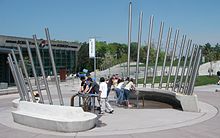
Public sculpture that is likewise a musical musical instrument (hydraulophone) by Steve Mann, which the public can play.
Some public art is designed to encourage direct hands-on interaction. Examples include public fine art that incorporate interactive musical, calorie-free, video, or water components. For example, the architectural centerpiece in front of the Ontario Science Centre is a fountain and musical instrument (hydraulophone) past Steve Mann where people tin produce sounds by blocking water jets to force water through sound-producing mechanisms. An early and unusual interactive public artwork was Jim Pallas' 1980 Century of Light in Detroit, Michigan[31] of a big outdoor mandala of lights that reacted in complex ways to sounds and movements detected by radar (mistakenly destroyed 25 years afterward[32]). Another case is Rebecca Hackemann'due south ii works The Public Utteraton Machines of 2015 and The Urban Field Glass Projection / Visionary Sightseeing Binoculars 2008, 20013, 2021, 2022. The Public Utteraton Machines records people's opinions of other public art in New York, such as Jeff Koon'southward Split Rocker and displays responses online.

An outdoor interactive installation by Maurizio Bolognini (Genoa, 2005), which everybody tin can modify by using a cell telephone.

New genre public art [edit]
In the 1990s, some artists called for artistic social intervention in public space. These efforts employed the term "new genre public art" in addition to the terms "contextual fine art", "relational art", "participatory art", "dialog art", "customs-based art", and "activist fine art." "New genre public art" is divers by Suzanne Lacy as "socially engaged, interactive art for diverse audiences with connections to identity politics and social activism."[16] Mel Chin's Fundred Dollar Bill Project is an example of an interactive, social activist public art project.[33] Rather than metaphorically reflecting social issues, new genre public art strove to explicitly empower marginalized groups while maintaining aesthetic appeal.[16] [34] An example was curator Mary Jane Jacob'south 1993 public art bear witness ''Culture in Activeness'' that investigated social systems though engagement with audiences that typically did non visit traditional art museums.[16]
Curated public fine art [edit]

The term "curated public art" refers to public art produced by a community or public who "commissions" a work in collaboration with a curator-mediator. An instance is the doual'art project in Douala (Cameroon, 1991) that is based on a commissioning arrangement that brings together the community, the artist and the commissioning institution for the realization of the project.[ commendation needed ]
Memorial public fine art [edit]
Memorials for individuals, groups of people or events are sometimes represented through public art. Examples are Maya Lin'due south Vietnam War Memorial in Washington DC, Tim Tate'southward AIDS Monument in New Orleans, and Kenzō Tange'due south Cenotaph for the A-bomb Victims in Hiroshima Peace Memorial Park in Nihon.[35]
Controversies [edit]

Public art is sometimes controversial. The post-obit public art controversies have been notable:
- Detroit's Heidelberg Projection was controversial for several decades since its inception in 1986 due to its garish appearance.
- Richard Serra'due south minimalist piece Tilted Arc was removed from Foley Foursquare in New York City in 1989 after office workers complained their piece of work routine was disrupted by the piece. A public court hearing ruled against connected display of the piece of work.
- Victor Pasmore's Apollo Pavilion in the English New Town of Peterlee has been a focus for local politicians and other groups complaining about the governance of the town and allocation of resources. Artists and cultural leaders mounted a campaign to rehabilitate the reputation of the work with the Baltic Centre for Contemporary Art commissioning artists Jane and Louise Wilson to brand a video installation about the piece in 2003.
- Sam Durant'due south Scaffold (2017), installed in the Walker Fine art Centre'southward garden represented the gallows used in seven authorities hangings. Native American groups found the work offensive, as 38 Dakota people had been hung at Mankato, Minnesota. The creative person agreed to dismantle and permit the tribal elders to burn and bury the slice.[36] [37]
- Maurice Agis' Dreamspace Five, a huge inflatable maze erected in Chester-le-Street, County Durham, killed two women and seriously injured a three-year-old girl in 2006 when a strong current of air broke its moorings and carried it 30 ft into the air, with thirty people trapped inside.[38]
Online documentation [edit]
Online databases of local and regional public art emerged in the 1990s and 2000s in tandem with the evolution of spider web-based data. Online public art databases can exist general or selective (limited to sculptures or murals), and they can exist governmental, quasi-governmental, or independent. Some online databases, such as the Smithsonian American Art Museum's Archives of American Art. It currently holds over 6 thousand works in its database.[39]
In that location are dozens of non-government organizations and educational institutions that maintain online public art databases of public artworks covering numerous areas, including the National Endowment for the Arts, WESTAF, Public Art Fund, Creative Time, and others.[40] Public Fine art Online, maintains a database of public fine art works, essays and case studies, with a focus on the United kingdom.[41] The Institute for Public Art, based in the UK, maintains data about public fine art on six continents.[42]
The WikiProject Public art project began in 2009 and strove to document public art around the globe. While this project received initial attention from the academic community, information technology mainly relied on temporary student contributions.[43] Its status is currently unknown.
See also [edit]
- ART/MEDIA
- Association for Public Art
- Environmental sculpture
- Listing of sculptors
- Lock On (street fine art)
- Murals
- Plop art
- Sculpture trail
- Site-specific art
- Statue
- Street installation
- Trompe-l'œil
References [edit]
- ^ Phillips, Patrica C. (1989). "Temporality and Public Art". Art Journal. 48 (four): 331–335. doi:10.2307/777018. JSTOR 777018. Retrieved 21 September 2020.
- ^ Smith, Roberta (2008). "Public Art, Eyesore to Eye Candy". Landscape Architecture Magazine. 98 (12): 128–127. JSTOR 44794099. Retrieved 21 September 2020.
- ^ Raven, Arlene, ed. (1989). Art in the Public Involvement. Ann Arbor and London: UMI Research Printing (University of Michigan. ISBN0-8357-1970-seven.
- ^ a b c Finklepearl, Tom (2001). Dialogues in Public Art. Cambridge, MA: MIT Printing. ISBN978-0262561488.
- ^ a b Gevers, Ine (ed.). Place, Position, Presentation, Public. Maastrict/De Balie, Amsterdam: Jan van Eyck Akademie.
- ^ a b "Americans for the Arts | Public Art". Americans for the Arts . Retrieved March 6, 2020.
- ^ Suderburg, Erika, ed. (2000). Space, Site, Intervention: Situating Installation Art. Minneapolis: University of Minnesota Press. ISBN0-8166-3158-one.
- ^ Ellsworth-Jones, Will (February 2013). "The Story Backside Banksy". Smithsonian Mag . Retrieved 22 September 2020.
- ^ Deitch, Jeffrey (2010). Swoon. New York: Harry Due north. Abrams. ISBN978-0810984851 . Retrieved 22 September 2020.
- ^ Rafael Schacter, "The World Atlas of Street Fine art and Graffiti", September, 2013; ISBN 9780300199420.
- ^ "Rafael Schacter and His "Globe Atlas of Street Art and Graffiti"". www.brooklynstreetart.com. 2014-02-13. Retrieved 2018-10-26 .
- ^ Bacharach, Sondra (October 2015). "Street Art and Consent". British Periodical of Aesthetics. 55 (4): 481–495. doi:10.1093/aesthj/ayv030 . Retrieved 22 September 2020.
- ^ a b c d e Jacob, Mary Jane (1992). Places with a By. New York: Rizzoli International Publications. ISBN978-0847815104.
- ^ Doherty, Claire, ed. (2009). Situation. Cambridge, MA: MIT Press. ISBN978-0262513050.
- ^ Kayden, Jerold S. (2000). Privately Owned Public Space. New York: John Wiley & Sons, Inc. p. 23. ISBN0-471-36257-3.
- ^ a b c d e f m h i j yard Knight, Cher Krause (2008). Public Art: theory, do and populism . Oxford: Blackwell Publishing. ISBN978-1-4051-5559-5.
- ^ a b Gude, Olivia. "Public Art Resource Center: Intertwining Practices of Public Art and Arts Education" (PDF). Americans for the Arts Public Arts Resources Centre (PARC). Retrieved 22 September 2020.
- ^ Fisher, David J. (1996). "Public Art and Public Infinite". Soundings: An Interdisciplinary Journal. 79 (1/2): 41–57. JSTOR 41178737. Retrieved 21 September 2020.
- ^ "Forms of Public Art | Western Commonwealth of australia Department of Arts and Culture". Government of Western Australia . Retrieved March half dozen, 2020.
- ^ "Interview with Rafael Schacter, Author of the Astonishing New Book: The World Atlas of Street Art and Graffiti ~ Fifty.A. TACO". L.A. TACO. 2013-11-13. Retrieved 2018-10-26 .
- ^ Brooks, Raillan (2013-12-06). "Droplets Art". The New York Times . Retrieved 2018-10-26 .
- ^ "Silence / Shapes – Filippo Minelli Studio". www.filippominelli.com . Retrieved 2018-10-26 .
- ^ Rosalind Krauss, "Sculpture in the Expanded Field", in: October, vol. 8, spring 1979, pp. 30-44
- ^ Plastik, in Zurich, Switzerland, 1931, and Brookgreen Gardens, 1932, Due south Carolina
- ^ Nov 26, Pratyush Patra | TNN |; 2016; Ist, 1:00. "Gurgaon needs public art on wildlife conservation, say artists who painted leopards on water tank | Gurgaon News - Times of India". The Times of India . Retrieved 2019-12-30 .
{{cite spider web}}: CS1 maint: numeric names: authors listing (link) - ^ Crouch, Angie (September 22, 2020). "Guerrilla Gardener Sparks Nutrient Revolution in South Central LA". NBC Los Angeles . Retrieved April 5, 2017.
- ^ McNeilly, Claudia (6 June 2017). "Meet the "Gangsta Gardener" Irresolute South Fundamental Los Angeles With Soil". Vogue . Retrieved 22 September 2020.
- ^ Weston, Phoebe (28 April 2020). "Gardens 'This is no damn hobby': the 'gangsta gardener' transforming Los Angeles". The Guardian . Retrieved 22 September 2020.
- ^ Eishen, James (23 June 2010). "Andrea Zittel discusses her work for IMA's 100 Acres". Artforum . Retrieved 22 September 2020.
- ^ Sheets, Hillary M. (nine June 2010). "100 Acres to Roam, No Restrictions". New York Times . Retrieved 22 September 2020.
- ^ "Pallas/Century of Light". jpallas.com . Retrieved 2018-10-26 .
- ^ Pallas, Jim (2017). "Century of Light Shines for Twenty-Five Years". Leonardo. 50 (three): 246–252. doi:10.1162/LEON_a_01151. S2CID 57560593.
- ^ Abrams, Eve (5 November 2009). "Fundred Dollar Neb Project Aims to Gear up New Orleans' Lead-Contaminated Soil". WWNO/New Orleans Public Radio. Retrieved 22 September 2020.
- ^ Greenish, Gaye (1999). "New Genre Public Art Education". Art Journal. 58 (i): 80–83. doi:10.2307/777886. JSTOR 777886. Retrieved 21 September 2020.
- ^ Kultermann, Udo (1970). Kenzo Tange. London, Great britain: Pall Mall Press. ISBN0-269-02686-10.
- ^ Kerr, Euan. "'Scaffold' sculpture'southward wood to be cached, Dakota official says". MPRNews. Retrieved 26 September 2020.
- ^ Miranda, Carolina A. (June 1, 2017). "Sam Durant Sculpture of Gallows in Minneapolis to be Dismantled and Ceremonially Burned". Los Angeles Times.
- ^ Stokes, Paul (24 July 2006). "Women killed as artwork floats off". The Daily Telegraph. London. [ expressionless link ]
- ^ "Fine art Inventories Itemize". Smithsonian American Art Museum; Smithsonian Institution Research Information Organization. Retrieved 22 September 2020.
- ^ "Public Art Resource Heart". Americans for the Arts. Retrieved 22 September 2020.
- ^ "Public Art Online". IXIA - Public Art Think Tank (owner and manager of Public Art Online/Arts Council of England. Retrieved 22 September 2020.
- ^ "Institute for Public Art: Research. Network. Advancement". Institute for Public Art/Network for Public Art, LTD. Retrieved 22 September 2020.
- ^ Mary Helen, Miller (4 Apr 2010). "Scholars Use Wikipedia to Save Public Art From the Dustbin of History". The Chronicle of Higher Education . Retrieved 16 October 2010.
Bibliography [edit]
- Cartiere, Cameron, and Martin Zebracki, eds. The Everyday Practice of Public Fine art: Art, Space, and Social Inclusion. Routledge, 2016.
- Zebracki, Martin. Public Artopia: Art in Public Space in Question. Amsterdam University Printing, 2012.
- Chris van Uffelen: 500 x Art in Public: Masterpieces from the Ancient Globe to the Present. Braun Publishing, i. Auflage, 2011, 309 S., in Engl. [Mit Bild, Kurzbiografie und kurzer Beschreibung werden 500 Künstler mit je einem Kunstwerk im öffentlichen Raum vorgestellt. Alle Kontinente (außer der Antarktis) und alle Kunststile sind vertreten.]
- Savage, Kirk. Monument Wars: Washington, DC, the National Mall, and the Transformation of the Memorial Landscape. University of California Press, 2009.
- Powers, John. Temporary Art and Public Identify: Comparing Berlin with Los Angeles. European University Studies, Peter Lang Publishers, 2009.
- Durante, Dianne. Outdoor Monuments of Manhattan: A Historical Guide. New York University Press, 2007.
- Ronald Kunze: Stadt, Umbau, Kunst: Sofas und Badewannen aus Beton in: STADTundRAUM, H., Due south. 62–65, 2/2006.
- Goldstein, Barbara, ed. Public Art past the Volume, 2005.
- Federica Martini, Public Fine art in Mobile A2K Methodology guide, 2002.
- Florian Matzner (ed.): Public Art. Kunst im öffentlichen Raum, Ostfildern 2001
- Finkelpearl, Tom, ed. Dialogues in Public Art. MIT Printing, 2000.
- Lacy, Susanne, ed. Mapping the Terrain: New Genre Public Fine art. Bay Press, 1995.
- Deutsche, Rosalyn. Evictions: Art and Spatial Politics. MIT Printing, 1998.
- Burgin, Victor. In/Dissimilar Spaces: Place and Retentiveness in Visual Civilisation. University of California Press, 1996.
- Miles, Malcolm. Art, Space and the City: Public Art and Urban Futures, 1997.
- Academy Group Ltd. Public Fine art, Art & Pattern. London, 1996
- Doss, Erika Lee. Spirit Poles and Flying Pigs: Public Art and Cultural Democracy in American Communities. Smithsonian Books, 1995.
- Senie, Harriet, and Sally Webster, eds. Disquisitional Issues in Public Fine art: Content, Context, and Controversy. Harper Collins, 1992.
- Crimp, Douglas. On the Museum's Ruins. MIT Press, 1993.
- Miles, Malcolm, et al. Fine art For Public Places: Disquisitional Essays, 1989.
- Volker Plagemann (ed.). Kunst im öffentlichen Raum. Anstöße der 80er Jahre, Köln, 1989
- Dear, Suzanne, and Kim Dammers. The Lansing Area Arts Attitude Survey. Michigan State University Eye for Urban Affairs, Lansing, 1978
- Herlyn, Sunke, Manske, Hans-Joachim, and Weisser, Michael (eds.). Kunst im Stadtbild - Von Kunst am Bau zu Kunst im öffentlichen Raum, (catalog for exhibition of the same name, at Academy of Bremen), Bremen, 1976
- Drove of scholarly publications on public fine art in Africa
External links [edit]
 | Wikimedia Commons has media related to Public art. |
- Infecting the City Public Arts Festival
- Public Art Archive™
- CultureNOW's MuseumWithoutWalls Public Art Database
- Public fine art at Curlie
- Public sculpture in Perth Australia
- Public sculpture in Cape Town Southward Africa
- Public art in Africa, web dossier compiled by the library of the African Studies Center, July 2019
Source: https://en.wikipedia.org/wiki/Public_art
0 Response to "Which Art Style Was Concerned With Public Life and Public Morals?"
Post a Comment